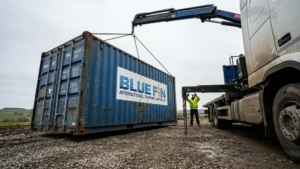
Most people picture a big steel box when they think of a shipping container. And fair enough, the standard dry container is the most common type. But there are quite a few different container types, each shaped around a specific kind of cargo or job.
Dry cargo containers, high cube units, open tops, flat racks, reefers, tanks — the list goes on. Below, we’ll walk through the main types and sizes so you can choose the right shipping container for your needs.
Key Takeaways:
- Standard dry containers tend to be the go-to for most cargo — they come in 20ft and 40ft sizes.
- Specialised containers (reefers, flat racks, tanks) exist for temperature-sensitive, oversized, or liquid cargo.
- Width stays the same across all ISO shipping containers — 8ft — which is what keeps container shipping so efficient.
- Picking the right container usually comes down to what you're moving, how much space you need, and your budget.
Standard Dry Cargo Containers — The Most Common Type
You’ve probably seen hundreds of these without thinking twice. The standard dry container — also called a general-purpose container or dry freight container — is what keeps global freight transport ticking. Fully enclosed, corrugated steel, built for general cargo like pallets, boxed goods, and machinery.
A 20ft container gives you around 33 cubic metres. A 40 foot container nearly doubles that. Both are 8ft wide and 8ft 6in tall — that uniform width is why container shipping works so well across ships, trucks, and rail.
High Cube Containers — Extra Height for Bigger Loads
At first glance, a high cube container looks identical to a standard one. The difference is height — 9ft 6in instead of 8ft 6in. Doesn’t sound like much, but that extra foot adds roughly 3–4 cubic metres of usable space.
High cube shipping containers have become popular for storage, pop-up shops, and conversions — the headroom inside the container makes a noticeable difference. They come in 20ft and 40ft sizes.
High cube shipping containers have become popular for storage, pop-up shops, and conversions — the headroom inside the container makes a noticeable difference. They come in 20ft and 40ft sizes.
Open Top & Flat Rack Containers — For Oversized Cargo
Some cargo won’t fit through a container door. That’s where these two come in.
Open top containers ditch the fixed roof for a removable tarpaulin cover. Heavy equipment, tall machinery, large vehicle parts — anything that needs to be lowered in from above using a crane.
Flat rack containers strip things back further — no side walls (or collapsible ones), just a steel floor and two end walls. Ideal for shipping goods that are oversized like pipes, boats, and industrial equipment.
Flat rack containers strip things back further — no side walls (or collapsible ones), just a steel floor and two end walls. Ideal for shipping goods that are oversized like pipes, boats, and industrial equipment.
Reefer Containers — Temperature-Controlled Shipping
Reefer containers — industry shorthand for refrigerated containers — have built-in refrigeration that holds temperatures from -30°C to +30°C. They’re the standard for perishable food like meat, fruit, and vegetables, plus pharmaceuticals and chemical substances.
These refrigerated shipping containers plug into a power source on the ship or vehicle, and some track temperature data in real time throughout transit.
These refrigerated shipping containers plug into a power source on the ship or vehicle, and some track temperature data in real time throughout transit.
Tank Containers — For Liquids and Chemicals
You’ll spot a tank container by the cylindrical tank sitting inside a standard ISO container frame. Purpose-built for liquid and gas cargo — dangerous goods, food-grade liquids, fuel, and chemical substances.
They have to meet safety standards set by the Bureau International des Containers (BIC), so they’re heavily regulated. Critical in the energy and chemical sectors.
They have to meet safety standards set by the Bureau International des Containers (BIC), so they’re heavily regulated. Critical in the energy and chemical sectors.
Specialised Containers — Double Door, Tunnel, Half-Height & More
Then there are the niche ones:
- Double door containers — doors on both ends, speeding up loading and unloading. Great for palletised goods.
- Tunnel containers — similar concept with end-to-end access, common in warehousing and distribution.
- Half-height containers — half the standard height, built for dense bulk cargo like coal, stone, or scrap metal.
- Hard top containers — removable steel roof panel for secure top-loading via crane.

How to Choose the Right Shipping Container?
Not sure what’s the right shipping container size or type? It usually boils down to three things:
- What’s the cargo? Dry goods suit a standard container. Perishables need a reefer. Liquids need a tank.
- How much space? A 20-foot container handles smaller loads; a 40-foot container suits bigger shipments.
- New or used? New containers are pristine. Used shipping containers offer solid value on a tighter budget.
Frequently Asked Questions
What are the four main types of shipping containers?
Standard dry cargo, high cube, reefer, and flat rack containers. These four cover the majority of shipping and storage needs.
What is the most common shipping container?
The 20-foot dry container. Used by practically every shipping company worldwide for general cargo. The 40-foot container is a close second.
Are all shipping containers the same width?
Yes — 8 feet across the board, whether it’s a 20ft or 40ft. That consistent width is what makes intermodal freight transport work so smoothly.
What is the standard size of a shipping container?
20ft and 40ft long, both 8ft wide, 8ft 6in tall. High cube versions add an extra foot of height, bringing them to 9ft 6in.
How many types of shipping containers are there?
Around a dozen — dry, high cube, open top, flat rack, reefer, tank, double door, tunnel, half-height, hard top, and a few other specialised types.